
Some thoughts on memory, writing, Hart’s War and the adaptation to film and other wild-eyed observations and a few genuine misgivings…
Something that intrigues me regarding the writing process:
Memory and the subtle and not-so-subtle ways it helps fashion plot, characters and story, so they all are sliced up into the stew of design.
Memory implies recalling the past.
But writing demands the energy of the present.
However, an interesting blend necessarily takes place. It seems to me – and this is an argument I frequently make that might be positive, maybe negative — but for every writer there is an element of themselves in each story told. It might be specific. It might be oblique. Obvious sometimes. Concealed often. But there is some dollop of ourselves inside any tale. It could be little more than a small drip. It might be a rushing current. And where does this come from? Our experiences. Something that gets registered inside us that might occur a minute ago or decade. Or two. Or three. Makes little difference, because it gets implanted within. And then remembered. Writing DNA. There’s a curious genetic basis for every story. This is true, regardless of what sort of fiction one is creating. A thriller? A novel of manners? A love story? Scratch away at that tale and there is a part of the writer threaded inside. A saint? A sinner? A conflicted character? Dr. Lecter or Rebecca of Sunnybrook Farm? Some juice is squeezed out from the writer’s personality. This is, I believe, how the foundation for a novel is established. A mixture of personal past and insistent present, boiled together in a stew of newly freed creativity. This becomes the measurements in the architect of fiction’s drawings. The rebar in the writing concrete.
Curiously enough, some of this returned to me recently, while watching the Apple Television series Masters of the Air. The series pricked my recollection about the genesis of my novel Hart’s War.
Which in turn, made me consider the subsequent film version of that book.
Start with a truism: When you’ve had movies adapted from your books, you will invariably get asked Just exactly what did you think about the film versions? How did you react when you saw your characters, your plot and your story up there on that big, unforgiving screen?
When I get this question, which is frequently, I generally reply with a joke:
“Well, everyone has walked out of a movie theater and overheard someone say, ‘The book was better…’. But I doubt anyone has ever stood outside a library and overheard someone exiting, saying ‘The movie was better…’”
A mediocre joke, to be sure. And not completely accurate. Often, yes, the book is better. But on significant occasions, maybe not so much. (Brokeback Mountain? Slaughterhouse Five? Dances with Wolves? Forrest Gump? Just to cite a few possibilities…)
The relationship between book writer and movie version is – as folks like to say in Argentina, invariably with an exaggerated shrug and a deeply knowing look: complicado.
Complicated. To put it mildly.
In my writing history, I have had four books filmed.
One was a television movie in France of The Wrong Man. It was admirable – sexy, twisted and energetic, even if I could only pick-up on a small percentage of the French dialogue. Another was an adaptation of my first novel In the Heat of the Summer which was filmed as The Mean Season (a descriptive line in the book). It starred Kurt Russell and he did a fine job portraying a newspaper reporter, other than the sequence where thinking that a killer (the estimable, late Richard Jordan) is going to kidnap his girlfriend (the quite lovely Mariel Hemingway) he jumps a drawbridge as it is being raised. Not routine reporter behavior when perhaps a phone call to a nearby police station might work as well.
And then there was Just Cause, which is a late-night cable staple nowadays and had many elements I truly admired. Ed Harris as a serial killer on his way to the electric chair, Blair Underwood as a maybe falsely convicted killer, and the late Sean Connery (I was told: “Do not ask him to say ‘Bond. James Bond…’”) who insisted on changing the main character’s name from Matthew Cowart (one letter quite deliberately off from coward) to Paul Armstrong – with an emphasis on those final six letters. He was a star. He got his way.
And then Hart’s War.
That’s the film I’m writing about now.
But first: Masters of the Air.
It stirred many memories about my old man, who passed away in 2012. And how he helped me, both knowingly and unwittingly, to construct Hart’s War.
Hart’s War is my only real historical fiction. It was oddly loosely and closely based on some of my father’s experiences during the Second World War. This sounds like a contradiction, but much less so than is obvious. Understand: He was like thousands of other young men who enlisted right after Pearl Harbor. December 7th, 1941. He had just finished his Fall semester at Princeton University – the college in the town where he was raised – and immediately signed up. Tried the Navy first – they didn’t like his eyesight and turned him down. It wasn’t a problem for the Army Air Corps, a distinction that usually made him shake his head with the clear-cut irony: eyesight is probably more critical flying in the air than sailing on the ocean.
There have always been two photographs of my father that haunted me.
The first – which I have had on my office wall for many years – is my father at age 21, very early in the war, kneeling beside the other crew members on the tarmac beneath the cockpit of Green Eyes, the B-25 bomber that 1st Lieutenant Katzenbach was assigned to as navigator. I would wager that more than a few aging members of the baby boomer generation have similar photographs of their fathers. Gathered beside the fuselage was one of the most common poses in 1942. Or by a tank. Or beneath the big guns on a fighting ship. There were many variations – but they were all fundamentally the same: Here we are, doing what is both right and our duty and trying not to imagine what might befall us. In my picture, my old man wears a sheepskin coat, collar turned up, a jaunty cap and a half-grin, I’m young and invincible look on his face. The picture was snapped the day before he and the rest of the flight crew were shot down over the Mediterranean skip bombing a German convoy bound for Rommel’s Afrika Corps.
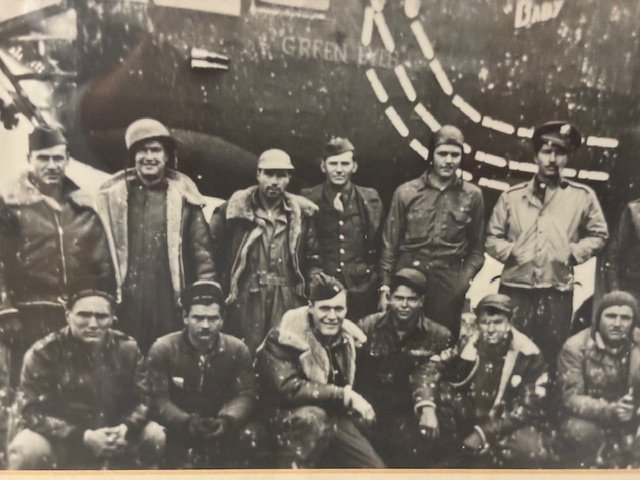
my old man with the crew of Green Eyes.
They went into the water at 200 miles per hour, engines aflame and about to explode. He was hanging on to a steel ceiling pipe, right behind the pilot and co-pilot. He later laughed about this. “I probably should have taken a seat…”
I asked him about that moment many years afterwards. Did he think he was about to die? And he replied, “Too much was happening to think about it. There wasn’t enough time to be scared.” Maybe that was true. Maybe it was not. I should have followed up with the obvious – that everything that was happening right at that moment in time was about death. But I did not.
The other photograph was the only snapshot he had of his nearly three years in German POW camp. He’s very thin and gaunt, in the tiny slightly more than passport sized photo – maybe 160 pounds stretched tight over his 6’2” frame – but he has a book in front of him and a smile on his face. It was taken at a time when there weren’t many smiles or meals to be had, but there were plenty of books to devour.
This picture got lost when he and my mother finally moved into a retirement home near Princeton, New Jersey where they both subsequently died several years ago – although both lived well into their 90s. I can still see that picture clearly in my memory and it pains me not to have it.
There were many other pictures of my old man taken over the years after the war, especially after his career in the law and government soared. Being sworn in as Bobby Kennedy’s deputy by Supreme Court Justice Byron ‘Whizzer’ White. Testifying in front of Congress. In the White House during the Cuban Missile Crisis. Seated across from LBJ, explaining some nuance of the law and the Constitution and how it might impact the great civil rights legislation they were working on. The most famous photo, of course, was him in front of the administration building, arms folded, slight exasperated look on his face, confronting George Wallace posturing “in the schoolhouse door” at the University of Alabama in 1963 as the governor whined and complained that segregation at the university was about to end. That picture almost always accompanies any article about the civil rights movement that rocked the USA in the 60’s. Along with Vietnam, our twin national catharses.

my old man at the University of Alabama
But the photo I regret not having, and the one that sticks in my memory, is that POW camp picture because it said a great deal about my old man. It is remarkable how a simple image can speak to a depth of psychology.
It was the book he was poring over in that picture – just lifting his head slightly for the secret snapshot – you can’t even read the title. Remember – no POW – kriegies they called themselves truncating the German word – were allowed anywhere near a camera, because photographs could be used for false identification in an escape attempt. This is accurately portrayed by the great British actor Donald Pleasance and the American movie star James Garner in John Sturges’ stirring film The Great Escape. (Steve McQueen doing his own motorcycle stunts, jumping barbed wire fences…Sir Richard Attenborough climbing rooftops… Charles Bronson panicking in a claustrophobic tunnel…James Coburn riding a bicycle to freedom…) That attempt happened in real life during the time when my father was a POW at Stalag Luft 3 in Sagan, Poland. He didn’t elect to try to join the men tunneling out from beneath the wire – although he did spend some time as a lookout. A good choice because most who did get out were subsequently killed.
Instead, much of his time, he studied. He had the Red Cross and the YMCA send him every book he would need for his junior and senior years at Princeton University, and when he did make it back home, he persuaded the faculty to let him write every paper and take every test in six weeks, so he could graduate on time with his class.
It is a well-known story. What he accomplished took on a nearly magical quality in my family. If you set your mind to it, you can accomplish anything. Obstacles, no matter how significant, are meant to be overcome.
He learned a great deal by studying. But what he achieved in that camp was hope.
Hope – as in I lived through ditching in the water. I lived through being starved in a cattle car while being transported to Germany. And now I’m going to live through this confinement no matter what happens. There’s a future for me. I just have to find a way to get there.
That was the primary underlying theme in the book Hart’s War – and it came directly from that photo of my old man. They were all soldiers in that (and the other) POW camps – but there was never a moment when live to fight again and live to get home wasn’t in their psyches. These are the essential tensions I carefully endowed in the story.
When I watched the Apple television series Masters of the Air which centered on the daylight bombing campaign orchestrated by U.S. Bomber Command and carried out by the airmen and crews of the U.S. 8th Air Force during World War 2, I remembered conversations I had with my father. He flew out of North Africa, which was dangerous enough, — after all, he survived ditching in the ocean after Green Eyes was shredded by anti-aircraft fire. But if you were a young man in the 8th Air Force flying out of England over Germany, your chances of survival were exceptionally low. (Read Elmer Bendiner’s book, A Fall of Fortresses). Daylight raids (highly controversial because of the risks involved) began well before the arrival of the P-51 long range fighters that provided excellent protection. Against German fighters. Not flak. I don’t believe any combat unit during that war sustained more casualties and kept fighting. In part, this was why when the Memphis Belle completed her 25 missions it was so Life Magazine remarkable. And, despite the upbeat tune, the words of the famous song Coming in on a Wing and a Prayer said much. “With our one engine gone, we can still carry on…” (Listen to Ry Cooder’s version with its haunting guitar work). The Apple series was adapted from the extraordinarily detailed accounting of that campaign written by historian Donald L. Miller, a professor emeritus at Lafayette College in Pennsylvania. Miller was gracious enough to include in his book my father’s academic approach while a POW and to quote me regarding the impact his studying had in my family.
I wonder frequently where that common man bravery so much routinely on display in the Second World War has disappeared. Replaced by incessant partisan posturing, useless braggadocio and outright lies – especially about what constitutes patriotism. What we have devolved to now, seems to me, less Nick Katzenbach representing future possibility and opportunity and more George Wallace standing obstinately in the way of progress, embracing a false and often terrible past. Maybe the emotional residue from Vietnam or the Gulf wars are partially responsible for this. Some large amount of blame goes to many in our current crop of politicians who don’t seem to comprehend history. Or even want to – preferring sniping and untethered insults and thoughtlessly playing to their base instead of doing the hard work of legislating. It is a loss that is sad to contemplate.
Masters of the Air was extremely well crafted – CGI techniques in this modern age are truly extraordinarily capable of putting a viewer right into action — and the actors are often compelling, capturing both the terror experienced and the dedication displayed by those fliers 80 years ago. That said, I did not think it quite as intensely personal as the companion pieces Band of Brothers or as relentlessly harrowing as The Pacific, which both aired on HBO.
Here is a personal aside: My uncle Ed – my father’s older brother – also left college to enlist in the Marines. He was in the Second Marine Division. A captain in what they then called pathfinders; he did close to a dozen landings under fire as the USMC fought across the Pacific during the years his brother was a POW. Brutal combat. Over and over again. He was wounded – several fingers shot off – and sent home shortly before the invasion of Iwo Jima. It was only years later that I wondered about that wound to his right hand. Some veterans might consider it a little too convenient – because it rendered him ‘combat ineffective’ and he was sent back to the states to work on war bond issues and stay alive instead of being in the first wave that went ashore into a holocaust of fire on Iwo Jima. But the USMC understood the stresses of combat and the impact they had on the psychology of soldiers, and Uncle Ed was rotated home with his medals and wounds, a good deal of military gratitude and few other questions.
Certainly, none that I ever asked him, when he came to visit and drank far too much. Although I suspect, as the years passed, he asked many of himself. He died, still young, by his own hand. One of those common family mysteries that had answers no one ever truly wanted to pursue, and which are lost now in the passage of so many years.
The Pacific, with its emphasis on the dehumanizing nature of that segment of the war, probably said a good deal about my Uncle Ed. As I watched it, I couldn’t help but think about him and what he’d experienced. (And I thought often of him and his war when I constructed a Vietnam ex-Marine veteran in my latest novel Jack’s Boys.) That acknowledged, the three series, taken together, present a comprehensive vision of the American engagement in World War Two – especially if coupled with Ken Burns’ fine documentary The War and Ernie Pyle’s moving and precise dispatches from the front. If you can read only one, it should be The Death of Captain Waskow, a heart-breaking simple, sparse column which still brings tears to my eyes. It is useful, too, to examine the Willie and Joe cartoons drawn by the great Bill Mauldin. Many other books, too numerous to mention, although E.B. Sledge’s With the Old Breed (one of the works used to create The Pacific) is as good as any place to start. Add in Joseph Heller’s cynical but highly accurate Catch-22. (My father took my brother and me to see that film version of the book. He sat in the theater constantly mumbling ‘That’s right… that’s right… I heard that…’ no matter how fantastic the story grew). In Catch 22, Heller’s main character John Yossarian discovers to his dismay that the only way out of flying combat missions was to claim he was crazy. But wanting out of combat proved he wasn’t crazy. “That’s some catch, that Catch-22…”
Also, naturally, see two of Tom Hanks’ movies – the brilliantly written and dynamically filmed Saving Private Ryan (two sequences have always stood out for me: Obviously the reconstruction of going ashore June 6th, 1944 on Bloody Omaha which was a feat that went way past nightmare; and the subsequent moments in the war office where women are typing furiously, and every letter is another despair… which bleeds into the scene of the army sedan with officer and priest arriving soundlessly at the Iowa farmhouse with four stars in the window.) But I was also impressed with the less prominent Greyhound on Apple television. The great director/producer Stephen Spielberg has his hands in many of these, along with Band of Brothers, The Pacific, and Masters of the Air. But don’t ignore The Best Years of Our Lives, if only for the deeply moving sequence when tank commander and former banker Frederic March returns to his home or the harrowing moment when Dana Andrews climbs into the front turret of the no longer needed B-17 about to be scrapped. William Wyler’s 1946 movie speaks to both the psychological impact of war and the nature of memory. A number of years ago, I had the mixed fortune to meet with Academy Award winner Harold Russell, the former Navy man who lost both arms in the war and whose transition to civilian life is a major theme in the film. Mixed because he was in Miami when I was a young reporter for the Miami Herald covering a criminal case that his son was involved in. He was a gentleman, even facing great personal dismay.
I could go on. And on. The literature and the cinema of the second world war is extensive. As it should be. Flags of our Fathers and Piece of Cake and All the Light We Cannot See and The Bridge on the River Kwai and Generation War and Dunkirk and The Cruel Sea…
But in truth, my thoughts often go to those two pictures of my father. One on my wall and one in my memory – memories triggered greatly by Masters of the Air because one of the final episodes in that series portrayed the airmen being marched from Stalag Luft 3 to Stalag 7A back in Germany. The survivors of that terrible midnight, mid-winter trek called it the long march. The episode and Miller’s book capture just how frightening and how dangerous that march was. If exhaustion captured you, you might be shot by the side of the road. If you succumbed to frostbite, you might be shot by the side of the road. If you fell out of step, you might be shot by the side of the road. Exhausted, panicky guards, and snow and ice. After miles hiking through sub-zero temperatures, under horrific conditions, the POWs were packed into cattle cars. No one knew where they were being taken. Most thought they were going to be executed. They were deposited at Stalag 7A, which wasn’t really equipped to handle the influx of thousands of half-starved and numbed prisoners.
But not that long after they arrived, they could hear Patton’s Third Army’s artillery in the distance. It was a tank column from that division that liberated my father in the Spring of 1945.
My father would never speak about that part of his war experience. He refused to share the memories of either that brutal march into uncertainty or the joy when he was freed a few months later. I was left to imagine how he felt when he saw the stars and stripes lifted over the camp, and the diesel rumble of the tanks crushing through the entrances, the mechanical sound echoing survival and freedom. And the music of hope.
On the other hand, he and I spoke extensively about his time in Stalag Luft 3, because that was how I came to formulate the plot to Hart’s War. As he grew older, and more willing to reflect, I understood many people had asked him about the studying he did in POW camp – because it is a great tale of persistence and dedication, and it became a staple of every profile interview he ever did over many years in the public arena. Call it what you like: American can-do spirit or perhaps a compulsive desire to keep learning. What he accomplished in those harsh years presaged much of how he lived his life (not an uncommon refrain for members of the greatest generation). It instilled in him a devotion to the law and how it could be used to better peoples’ lives. Being a POW taught him what it meant to have freedom ripped away and that the rights we often take for granted are more precious than imaginable. When he arrived at Stalag Luft 3, he was a very young man, with an uncertain future, thrust into a world of great doubt and constant unease, bordering on fear – because as he told me, everyone in the camp knew that if the German guards received an order from Berlin to execute them all – they would have. Without hesitation. His memories spoke to a different impact emotionally than the simple, easy story of his studying, and that was what fascinated me. I wanted to understand the clay that he’d formed and hardened into his life. Although, honestly, I entered these conversations with no idea there was a book about to happen. The impetus for the novel was a single conversation late one evening. I off-handedly asked him, “Were there any crimes in the camp?” And he replied, “Yes. There were a couple of instances of theft, which were very serious because we had so little. The Germans let us adjudicate these ourselves. Sort of military tribunals, with statements and witnesses…”
And as he said this, I imagined something that spun off what my old man had told me:
A young, soon to be lawyer, modeled on who my old man would later become.
A Black Tuskegee Airman arriving at the camp. One of the famed “Red Tails” that never lost a bomber they escorted to enemy fighters.
A murder of a racist officer.
A trial.
A tunnel.
In other words, a novel.
At first, I did not tell my father I was embarking on a story close to his experience. When one launches into a novel there is always an element of doubt – as in can I pull this off? This was coupled with the usual and sadly common writerly inward sensation that telling any story is a risk. It simply might not work. (I often think of the old cliché that was a staple at the Boeing airplane manufacturing company – they called designing and building and marketing a new jet ‘Betting the Company’ – because if they failed in any aspect of the engineering, they would effectively destroy their own livelihoods. Writing, especially novel writing, seems to me, to take on some of the same characteristics). And I didn’t know if Hart’s War would embody the necessities: Was there tension? Were there the proper dynamics between characters? Was there a beginning that would capture readers, a middle that would keep them engaged, and most critically, an ending that would remain in their memories after they closed the final pages down? And I had added misgivings, because Hart’s War would be – at least in part – a head-nod to history, not a contemporary story jumping from my newspaper days, which was the arena where my prose generally found its home.
My father deduced what I was working on later in other conversations we had. After all, he was a skilled lawyer, and accustomed to eliciting confessions. And once the novel got rolling, I ceased hiding what I was doing – although I never outlined the plot to him until the manuscript was completely edited and finished and he could read the book in its entirety. But it was during these early conversations, when he was sort of in the dark about the book that he made it clear to me that it was not only important to capture camp life with accuracy, but to make certain that the underlying psychology of being a POW was intact on my pages. This was, in many regards the largest challenge. Not only did I have to probe his memory – but I had to look deep within myself, measuring every moment of doubt and despair I could recall, even when they paled in contrast to what my father went through, to subtly slide them into Tommy Hart – my character – so that he could overcome them. I couldn’t simply have him succumb to uselessness. He had to know the unsettled nature of fear while at the same time dreaming of a future. He had to embody that same hope that my old man gripped so tightly month after month inside Stalag Luft 3 and was finally realized when those tanks entered Stalag 7A.
Another aside: On his bookshelf in his Princeton home, for many years my father had an old, dog-eared, often-read first edition copy of David Westheimer’s wonderful thriller novel Von Ryan’s Express. (Book, excellent. A tour de force. Worth reading today. Movie version, with Frank Sinatra and Leslie Howard, equally wonderful). It was inscribed to my father with the words Nick – if only it had been like this… I subsequently relied greatly on Westheimer’s detailed memoir Sitting It Out to get camp life right. Both in respect to the day-to-day activity, but more critically with the emotional stress daily living behind those sentry turrets, machine guns and barbed wire wreaked on the men. Lucky to be alive. Frightened that they would be forgotten. Aware that every day – no, every hour – might be their last. Westheimer – also shot down over Italy — had been in the same barracks as my old man.
Every day that I sat at my computer constructing Hart’s War I kept a single admonition in my mind. I didn’t want to get a letter from an 80-plus-year-old veteran of POW camp after the book came out with the words ‘it wasn’t like that…’ and ‘you’ve got it all wrong…’
And I particularly didn’t want that letter from my father.
It seems to me that hidden in every novel, there is an obligation. Certain truths need to be underscored. Some psychology needs to be portrayed accurately. The words on the pages – again, regardless of genre (even science fiction)—need to reflect emotional subtleties, because every reader who sets eyes on those words has, even in an unrecognized or unspoken part within them, a connection to those truths. Perhaps this sounds a bit on the Freudian side of matters. I suspect it is.
One of the novelist’s duties is to recognize that obligation and honor it in his/her prose.
Obligation is a strong word. Necessarily so.
It might be hidden from the reader, caught up in character and plot – but it is there – even in that book you pick up for an airplane flight festooned with quotes using words like the best yet and thrilling and seat-of-your-pants all of which are designed to make a reader think he won’t have to think, when he/she actually will.
Every book contains a responsibility. A duty that the author must honor and defines the relationship between writer and readers.
And this, I believe, reflects the fundamental difference that marks the distinction between sitting and reading a book and sitting and watching a movie or television show. (I would argue that going to a play is closer to reading – because one is finely tuned to the words spoken on stage, and the impact they have on the performers – who are, in a way standing in for you and me. And, up on the stage, they are real. There is no celluloid barrier between them and us.) But the world of movies and television has a different psychological effect on folks. When we read, we are active. We consider what we see on the page (even if inadvertently, in our unconscious, because we are still processing). When we watch, we accept. This is not to say that the emotions inspired can’t be equally profound – think of the hundreds of bits of movie dialogue that come easily to mind: “Frankly, my dear, I don’t give a damn…” or “I’ll be back…” or “Forget it, Jake. It’s Chinatown…” or “We’re going to need a bigger boat….” Simply say those words out loud and we can see in our mind’s eye Brody backing into the cabin and Quint looking up, slightly astonished until he instantly recognizes what it means… The cliché there wasn’t a dry eye in the audience speaks to the power of film. While I can recollect my excitement when I tumbled headlong into any number of stories (The Lord of the Rings, The Charterhouse of Parma, Crime and Punishment, Great Expectations, For Whom the Bell Tolls…) when I was growing up, the impact of those tales was psychologically different from the cinema moments I will never forget. I will never get over barely being a teenager and falling wildly, madly, utterly in love with the striking Julie Christie (who could be more beautiful, more compelling to anyone exiting adolescence?) in her very first movie, an11-minute role, in the Tom Courtenay film Billy Liar. Nor will I ever forget the sense of stand-up and shout excitement, the outright thrills, of watching the very young Michael Caine (also his first movie role) and Stanley Baker in Zulu – a film, intimately and relentlessly based on real life events, that remains, at least in my mind, the template for an action/thriller. To this day, it is easy to recall the sensation of complete edge-of-seat abandonment as Gene Hackman races beneath the subway tracks in The French Connection – another perfect example of filmmaking that captures – no, seizes — a viewer. A different sense I remember, when, as a teenager, walking out of a screening of Easy Rider suffused with rage after the dramatic final scene. Similarly heartsick after the last sequences in Coming Home especially when Bruce Dern sadly walks into the ocean. (It would be nice if the other stars in that estimable film, Jon Voigt and Jane Fonda, remembered today what their characters were saying about America back then…). Or, conversely, roaring with laugh-joy when I first saw Cleavon Little and Gene Wilder in Mel Brooks’ ground-breaking Blazing Saddles. Has the “N-word” ever been used more effectively in such a disarming fashion? Or consider: Fear, sudden, astonishing and re-defined, when the alien exits John Hurt’s chest in Alien. But, in my opinion, we don’t interact with words on a page, or words spoken on a stage in the same way that we do when the words and actions on a screen flow over our passive selves. Books and theater engage us. Film and (on occasion –consider Prime Suspect, E.R., The Sopranos or Game of Thrones) television engulfs us.
I love movies and television as much as I do books.
Just differently.
Here are some truisms: The love we feel for our children isn’t the same as that we feel for our spouse. Teenage or college-age love/passion, is different from adult, mature ‘we should start a family’ love. We love our pets (‘Here, boy! Now, sit! Who wants a cookie?’) differently from the way we love our home (‘I’ll be in the garden weeding, if anyone wants me…’), or our hobbies (see my fly fishing and writing essay) or our friends. Easy to go on and on about this, although finally, we reach the point where we recognize the way we love our country differs from all the other sorts of love.
Which, in a roundabout manner, brings me to the issues I had with the film version of Hart’s War.
I wanted to love it.
I didn’t.
If you, reading this, haven’t read that book or seen the film adaptation, then I apologize, because this next section relies on specific knowledge.
Here is my fundamental problem with the film:
The filmmakers didn’t understand – and I don’t believe ever tried to understand – that obligation that I in my “author’s” role was so attuned to when I described Tommy Hart’s B-25 bomber hurtling towards the Mediterranean in very much the same way Green Eyes did with my father clinging to that pipe.
I don’t think it is appropriate for any author, much less myself, to whine about every change filmmakers install in a story to bring it to the screen. After all, trying to condense a 400 plus page novel into a two-hour movie is an enormous creative challenge, and terrifically difficult under almost any circumstances. It takes highly refined visual and writing skills and a real understanding of the incessant demands of fine drama. And, in the case of Hart’s War, the production team was excellent. It should have been great. Fine director. Dedicated producers. Outstanding actors (Bruce Willis, Colin Farrell, Terence Howard and Linus Roache…). But let me delve into a couple of crucial changes they made that I believe crippled the adaptation. These were the sort of changes that defied accuracy, both historically and psychologically.
After the initial screenwriter was fired…
A typical Hollywood event. Happens all the time, on film after film…
(Partly because the first guy wanted to film that B-25 heading into the water sequence…).
They grounded the production.
They switched the camp from Stalag Luft 3 to Stalag 7A. Or a camp that looked suspiciously like Stalag 7A.
And they swapped Spring/Summer of 1943 – when the book is set – for the winter of 1945. Tommy Hart is no longer a flyer shot down early in the war. Now he was what front-line veterans used to call a REMF. That stands for “rear-echelon motherfucker…” And instead of guiding a bomber – like my old man did – into a hail of fire, he is captured during the Battle of the Bulge, mistakenly stumbling into an ambush performed by German soldiers wearing captured US Army uniforms (this ruse did occur. Usually ineffectually…)
Several critical facts ignored:
In a POW camp in 1943, uncertainty was a constancy. The invasion of Normandy had not occurred, and nothing militarily had been settled. This atmosphere of doubt created the critical psychological backdrop for Hart’s War the novel. It was absent in Hart’s War the movie. That was the inherent tension that I exploited, working with my father’s memories of that time. It was the pillar for the book. In my opinion, it is the element that made the novel work. As any fiction writer knows, creating the milieu for tension only layers more onto the page. Consequently, shifting the time frame created huge historical issues for the production – not the least of which was it is not feasible to be digging a tunnel in the harshest European winter in 100 years when all you have are makeshift shovels and hand tools to get through frozen ground. And, tangentially, in the terrible winter of 1945 we were winning. And this salient detail made escape problematic. Some men during the long march from Stalag Luft 3 to Stalag 7A did slip away to take their chances in the countryside. A risky maneuver. But an organized tunnel escape from Stalag 7A – when (as I mentioned earlier) every man knew Patton’s 3rd Army was closing in? Not a chance. Again – this historical shift caused the production to need to create an artificial reason men might be tunneling out of the camp (in a month where you couldn’t dig…). They came up with a rationale that was unreasonable – a word I’m trying to gently substitute for what I truly feel, which is much closer to ludicrous and ridiculous. That substitute was the idea that Bruce Willis was going to lead unarmed men on some sort of quasi suicidal commando raid on a nearby munitions factory that was allegedly concealed as “a shoe factory” thus somehow evading destruction. The problems with this scenario were extraordinary. First, how would the POWs know it was munitions, not shoes and U.S. Bomber command not? Second, why wouldn’t a shoe factory (if there even was such a thing in 1945, which I doubt… I will have to check with shoe manufacturing historians) be bombed? Everything else in Germany was. And I’m not a military guy, but I suspect soldiers without shoes in the winter are not likely to fight. And lastly, a commando raid to blow up a factory, even one making bombs or bullets, isn’t the easiest engineering feat around, when one has no detonating equipment handy. And no weapons with which to seize the factory in the first place… and… and… and…
You get the idea.
In other words, to have some additional explosions at the end of the film the filmmakers sacrificed any pretense to historical accuracy.
But the far larger sin, in my eyes, was ignoring the psychological accuracy. The emotional nature of being a POW was set aside in favor of cinematic expediency.
This kind of trade-off rarely works.
Novelists know this. Most filmmakers do, too.
(See Tarantino, Quentin and Pulp Fiction and both Kill Bill 1 and Kill Bill 2. Re-watch Gillo Pontecorvo’s intense The Battle of Algiers. Or the Argentine 2009 El Secreto de Sus Ojos — not the USA remake.)
That psychological accuracy may manifest itself differently in a novel than it does in a film. But it is still crucial.
And abandoning it in favor of “action” was an immense flaw.
I hesitate to say unforgiveable. But bordering on that realm.
But here is something they got right in Hart’s War:
Early in the film there is an impressively dramatic scene, where POWs are crammed into locked cattle cars to travel to the camp. They pull into a train station – only to hear the roar of oncoming P-51 fighters armed with rockets and bombs attacking the station – and the train that has just arrived. It is the sort of sequence that Hollywood does exceptionally well. Incredible special effects mixed with physical accuracy. It cuts between explosions as the station and the German soldiers defending it are destroyed, and the POWs trapped in the cattle cars, dying as machinegun bullets spit from the planes rip through the wooden roof. It captures the panic and death with striking immediacy. It screams with the realism of war.
I admired this sequence immensely.
It was first shown to me in a screening room in Prague, where they were finishing the film and where the production had built their POW camp. I was accompanied by my father, then an old man, partially crippled by a bone disease, but still as intellectually sharp as he was years earlier, and by my son, who was spending time on the set, soaking up the filmmaking experience. MGM had flown us over to do some publicity for the movie.
The producers, the director and some of the stars were in the screening room, as well.
We watched as those P-51’s tore up the screen. We saw the bullets shredding the men locked in the cattle cars. We saw the fine actor Adrian Grenier vaulting through a small window, crashing to the hard ground, stitched by bullets, but still able to open the cattle car doors and free the men trapped inside.
It is not a long sequence. But it is a gut punch, emotional and artistic, as well as explosive and dramatic.
When it ended, the film crew turned to me. What did I think of what I’d seen…
I responded truthfully. I told them I believed it incredibly dramatic.
Then they all turned to my father, who was sitting quietly to the side, seemingly absorbed by thoughts.
What did he think?
A momentary hesitation, as he gathered his reply inwardly.
“Well,” he started slowly, “I wish you’d stuck with John’s description of being shot down…”
There were a few nervously shared looks at that moment by the filmmakers…
“… But that is a very powerful sequence. And…”
He hesitated again, before continuing in a very soft voice:
“… That is precisely what it is like to be strafed by your own guys when you’re trapped in a cattle car.”
Silence.
Five seconds. Ten. Twenty seconds…
Then I said:
“Dad, you never told me that happened to you.”
He shook his head.
“Not a great memory. And in my case, it was P-38’s not P-51’s. And we got free the same way that they did in the film. A guy managed to get through the little cattle car window and open the doors from the outside.” He smiled then. “The fellow was a gymnastics All-American, I believe. Quite a feat. Probably saved all our lives.”
Interesting moment, then:
My father re-gripped silence. It was easy to see the memories flooding him. On the other hand, the filmmakers were overjoyed in a sort of the old vet who was there told us we got it right… sense. The contradiction struck me. They were happy – and legitimately so. But all my father remembered was the men who’d died to his right and left so many decades earlier. I wondered if he could see their faces.
Two other moments on that trip stand out:
The first – and it bothers me to this day – was when we walked onto a studio set while they were filming a scene with Willis and Farrell. In the background as the two stars talk, POW extras are rehearsing a stage revue – a common enough form of camp entertainment at Stalag Luft 3 – although less so at Stalag 7A. But… and this is a huge BUT… the men in the “revue” are mocking Nazi salutes and Teutonic history with caricatures of Hitler and others in the background.
My father took one look, shook his head and said: “Impossible.”
He continued:
“If the camp commanders ever saw anything making fun of Hitler, they would have shut down the production instantly. And maybe tossed all the participants into the cooler. Or worse. They might have shot them. Making fun of Hitler? The Nazi party? The German leaders? Not ever going to happen…”
I spoke with a producer later that day. “Can they edit out that background?”
“No. Too difficult.”
This sort of exemplifies the issues with the film. Told that something was demonstrably wrong they had no answer. Or none that looked to a solution.
I was asked to ignore that sort of problem.
And I was asked to request my father do the same.
It was probably harder for him, than me, to honor that request. But we did. For me, well, it was please embrace hypocrisy; I’d been paid enough so I was incentivized to keep my mouth shut. In fact, it was in the contract. He hadn’t been paid a cent, so not speaking out about obvious errors was only a father’s efforts to not make matters harder for his son, as difficult as that might have been for him to keep quiet. That deserves respect.
And the other moment:
After we were driven to the outdoor set where they’d reconstructed the POW camp, we were escorted into one of the fake barracks. For a second or two, my father stood stiffly. I saw him take a deep breath and swallow hard to control runaway emotions. Then he softly whispered, “I never thought in my life I’d ever see this again…”
I believe for him in that moment, it was like recalling an unsettling dream, one that verged on nightmare.
I suspect it would have been the same for virtually all the ex-POWs.
Over the years, he would make a few jokes about the film. Privately. In any public mention, he was always positive. But that was more a reflection of the book Hart’s War that he seemed very proud of, than the film. His enduring nature was to always be extraordinarily polite and at the same time he was loathe to be too critical. (He was even forgiving of George Wallace, the Alabama governor he’d confronted in that iconic 1963 moment.) In a way, his reactions to the book and film of Hart’s War and the way I perceived them, underscore the rocky relationship between author and adaptation. There are some aspects that are wonderful. And some that are terrible. One simply hopes that the pendulum swings more often to the former than the latter.
Sometimes it does. Often, it doesn’t.
My father is gone now, as are most of his generation. He achieved many notable things during his 90-plus years. Met with Presidents, Kings and Queens and famous folks of all stripes and races. Fought for values that we far too often take for granted. Saw many of his victories in those battles become a part of policy and subsequently a part of society. Disdained celebrity much of the time. Marched with the vast crowd of ordinary folks at Martin Luther King Jr.’s funeral instead of up front with the famous types – a detail not lost on that most dedicated family, who forever held him in high regard. Stood beside LBJ as the great civil rights legislation was enacted, that our current, uninformed SCOTUS doesn’t seem to think is relevant or necessary any longer. It would be nice if they walked outside of the Supreme Court Building on occasion and listened. And, even though he was routinely named to the American Bar Association’s list of 100 best lawyers in the land, he didn’t play on those accomplishments to make himself overly rich. No private jets and hand-tailored suits. Looking back on his life, he had much to be proud of, and there was much that he did that made all of us in his family proud of him.
But I remember those two photographs. And I sometimes wonder whether living through all those harsh days that stretched into rough years behind barbed wire staring up at the towers, machineguns and stony-faced guards, weren’t in some fashion his finest moments.
Like I said at the beginning of all this: Memory and personal history blend for a writer.
I think, hope, pray I did his experience justice in the novel Hart’s War while telling a story that would reach out to readers, engage them and make them think about that era and the men (and women) who were a part of it. I only wish the film had managed the same. Explosions on the screen, ultimately, weren’t all that important. Finding truths were.
Amherst, Massachusetts
June 2024
 English (United States)
 English (UK)